
The Stone She Almost Walked Past
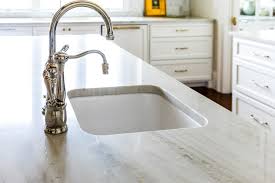
She thought she wanted granite.
She'd seen it in magazines. Classic, durable, the stone her mother had. But every slab she looked at felt too busy. Too much movement. Too many colors pulling in different directions. It wasn't right for the kitchen she had in her head.
So she moved to quartz.
She liked the idea of it — low maintenance, consistent, no sealing. And the veining looked right. Soft. White. Subtle. But something was off. The more she looked, the more she felt it. The surface was flat. There was no depth. No life. It looked like a photograph of a stone, not a stone.
She kept looking. Her husband stopped asking how it was going.
Then, toward the end of a long afternoon at the stone yard, she saw a slab she didn't recognize. White base. Feathery gray veining. A soft matte finish that made her want to put her hand on it.
The tag said Mont Blanc Quartzite.
She had no idea what quartzite was. But she knew this was different. The stone had depth. It had quiet movement. It looked alive in a way the quartz samples never did.
She needed to know more.
What quartzite actually is
Quartzite is natural stone. It starts as sandstone — ordinary quartz-rich sand — and gets buried deep in the earth. Heat and pressure transform it over thousands of years. The sand grains fuse into a dense, hard mass.
That process is why it looks like marble but behaves like granite. The same slow transformation that gives it soft, flowing veins also makes it one of the hardest stones you can put in a kitchen.
Mont Blanc comes from the Chapada Diamantina region of Bahia, Brazil. It's a true quartzite — not a dolomite, not a soft marble wearing the quartzite label. When you run a knife tip along a hidden edge, it won't scratch. When you put vinegar on an unsealed corner, nothing happens.
That matters. A lot of stones sold as quartzite can't say the same.
What it looks like in a kitchen
Mont Blanc quartzite in a kitchen reads clean. Calm. Present without being loud.
The base is soft white — milky, not stark. The veining runs in feathery gray and taupe patterns. Subtle and wispy, not bold. The kind of stone that works in a modern kitchen, a farmhouse kitchen, a coastal kitchen. It doesn't fight with your cabinets. It settles in.
It comes in polished, honed, and leathered finishes. The honed finish is what she touched that afternoon — smooth and matte, closer to the feel of real marble. The polished finish brings out more color depth. The leathered finish adds texture and hides fingerprints better than either.
It pairs well with warm wood tones, white shaker cabinets, dark charcoal lowers, brass hardware. Designers specify it across a wide range of styles because it doesn't lock you into one look.
That versatility is part of why it took off. Install photos of Mont Blanc islands and waterfall edges spread through design blogs and Instagram. Showrooms made it a flagship. Fabricators started stocking it regularly. Once enough people saw it in real kitchens, demand followed.
How it performs
Mont Blanc is hard. It resists scratching. It handles heat better than most engineered surfaces — though trivets are still a good habit with any stone.
It is far more resistant to etching than marble. Marble etches because it's calcium carbonate — acid dissolves it. Quartzite is silica. Acid doesn't touch it. Lemon juice, vinegar, tomato sauce — they're not threats to the stone. They're threats to the sealant. There's a difference.
Seal it at installation. Reseal every 12 to 18 months. The water bead test tells you when: a few drops on the surface. If they bead up, you're fine. If they soak in, it's time.
Day to day: warm water, mild dish soap, soft cloth. That's the whole routine. Wipe up spills promptly — not because the stone can't handle them, but because the sealant works better when you help it.
Homeowners who've had Mont Blanc in active kitchens for several years report the same thing. It holds up. It still looks right. It was the right call.
What Mont Blanc quartzite costs
A Mont Blanc quartzite slab runs around $4,000. That puts it in the same tier as Taj Mahal — premium Brazilian quartzite pricing.
Installed, budget $100 to $150 per square foot in most Massachusetts markets. A typical kitchen comes in at $5,000 to $9,000 depending on square footage, edge profile, and whether you're doing a backsplash.
That number surprises some people. But Mont Blanc sits in the sweet spot fabricators know well: it sells like a high-end marble and performs like a premium granite. Over ten or twenty years in your kitchen, that math works out.
A price that seems too good is worth a question. Real Mont Blanc quartzite, properly sourced, doesn't come cheap. If it does, ask what you're actually looking at.
She ordered the Mont Blanc.
It went in on a Tuesday. Honed finish. Full backsplash. She stood in her kitchen that evening and put her hand flat on the surface, the same way she had at the stone yard.
Still right.